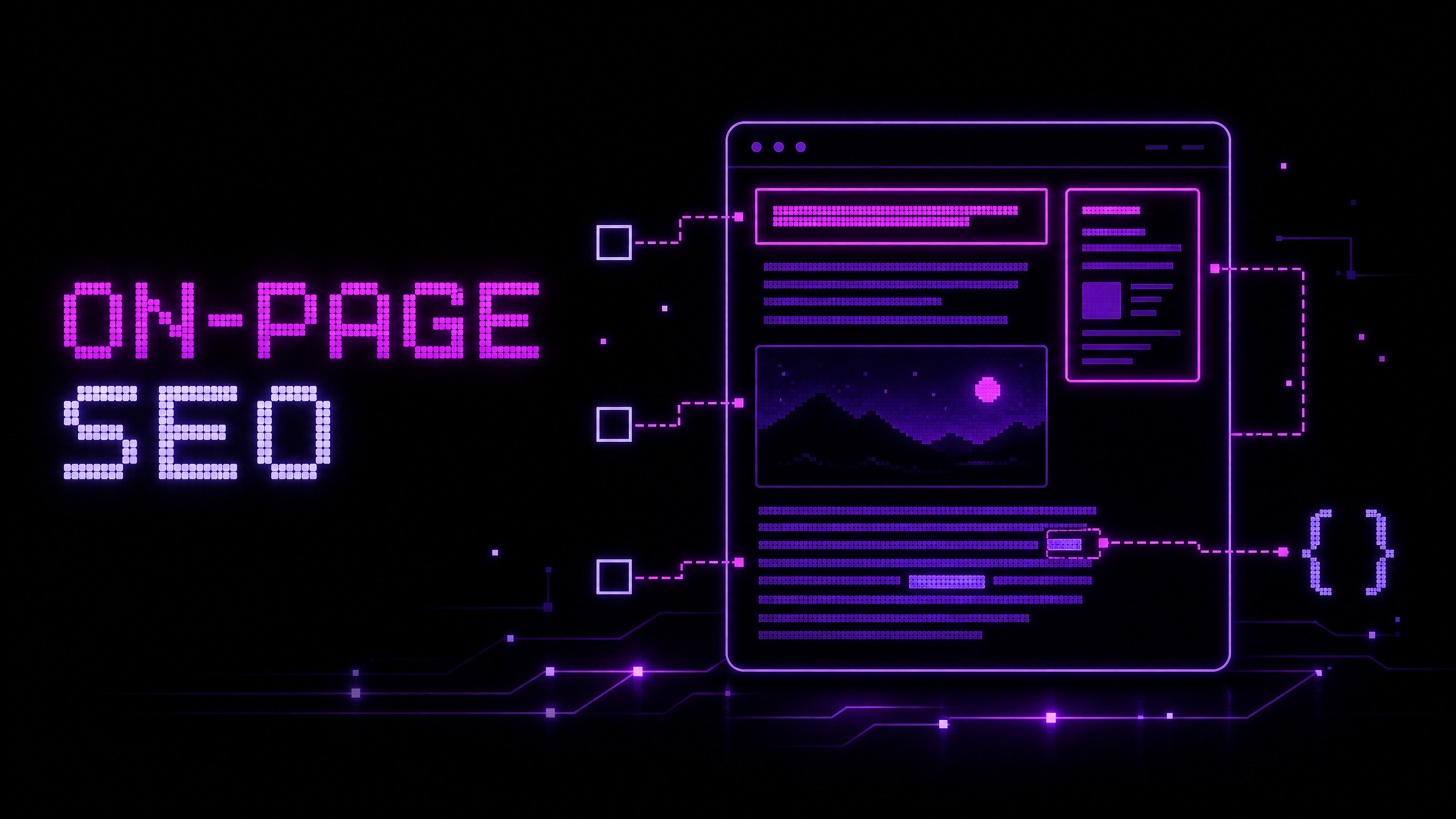
On-Page SEO Explained with a Real Web Page Example
On-page SEO refers to the work done on a webpage to make its content clearer and more useful for visitors and search engines. It includes the visible content, page title, headings, links, images, metadata, technical structure, and—in suitable cases—structured data.
On-page SEO is not a collection of places where the same keyword should be repeated. It is the process of making one page clearly answer one main need.
Google’s guidance says title links should be descriptive and concise, and meta descriptions should provide a relevant summary of the specific page.1 Semantic HTML and meaningful links also improve the structure and accessibility of the page.3
This article uses a fictional example: a service page for a web developer offering e-commerce SEO for small businesses.
Step 1: Define the page’s purpose
The example page should help a small-business owner understand what the service does, whether it is relevant to their store, what the process includes, and how to request a conversation.
Its primary search intent is commercial investigation. The visitor may be comparing providers or trying to understand whether e-commerce SEO can solve problems such as weak product discovery, inaccurate product data, or unclear category structure.
The page should not try to rank for every SEO phrase. It should serve one focused purpose and link to more detailed guides for related questions.
Step 2: Choose a descriptive URL
A clear URL might be:
https://example.com/services/ecommerce-seo
This is easier to understand than a URL filled with internal IDs or unrelated parameters. Keep it stable, use lowercase, and avoid changing it without a reason. If a URL must change, plan the redirect and update internal links.
The URL is not a substitute for useful content, but a descriptive structure supports clarity for users and site maintenance.
Step 3: Write the page title
Google recommends a title for every page and advises using descriptive, concise text without keyword stuffing or repeated boilerplate.1
A weak title might be:
<title>SEO SEO SEO | Best SEO SEO Services</title>
A clearer title is:
<title>E-commerce SEO Services for Small Businesses | Rutaab Ali</title>
The improved version identifies the service and audience and includes the brand without repeating the phrase unnaturally. Google may use the title element, visible heading, prominent page text, links, or other sources when generating a title link, so the page should be consistent rather than trying to manipulate one field in isolation.1
Step 4: Create a useful meta description
A meta description is a short summary that may appear in a search snippet. Google recommends unique, relevant descriptions for individual pages and warns against long keyword strings.2
Example:
<meta
  name="description"
  content="Improve product discovery, category structure, and technical SEO for your online store with practical e-commerce SEO support."
>
This description tells a potential visitor what the service addresses. It does not claim guaranteed rankings or a specific traffic increase.
Google may use another passage from the page when it believes that passage better describes the search, so the visible introduction should also be clear.2
Step 5: Use one clear main heading
The page might begin with:
<h1>E-commerce SEO that helps customers find the right products</h1>
The H1 does not need to duplicate the title word for word. It should clearly communicate the page’s main promise and match what follows.
A possible heading structure is:
H1 E-commerce SEO that helps customers find the right products
  H2 What the service helps you improve
  H2 What is included
    H3 Product and category structure
    H3 Technical SEO checks
    H3 Product data and structured data
  H2 How the process works
  H2 Who this service is for
  H2 Frequently asked questions
  H2 Request an SEO review
Do not choose headings only because they contain a keyword. Use headings to create a logical outline that helps someone scan the page.
Step 6: Write an introduction that answers the visitor
A useful opening could be:
If customers struggle to find products, understand categories, or trust the information on your online store, e-commerce SEO can help improve the connection between your catalog and your audience. This service reviews product and category pages, technical foundations, internal links, and structured product information so your store is easier to understand and use.
This opening identifies the problem, explains the service, and avoids promising a guaranteed outcome.
Step 7: Explain what is included
The body should give enough detail for a potential client to assess relevance. For example:
Product and category structure
Review category names, hierarchy, navigation, filters, breadcrumbs, URLs, and internal links so visitors and search engines can understand how products relate to one another.
Technical SEO checks
Review crawlable links, indexation controls, redirects, canonical signals, page speed, mobile behavior, accessibility, sitemaps, and important template problems.
Product information
Check titles, descriptions, images, specifications, variants, price, availability, shipping, returns, structured data, and marketplace or merchant feeds for consistency.
Measurement and iteration
Connect recommendations to measurable outcomes such as qualified search impressions, product-page visits, enquiries, add-to-cart behavior, or other business goals.
The exact scope should reflect the service you actually provide. Do not list tools, audits, or deliverables that are not part of your process.
Step 8: Add proof without inventing results
Proof may include a portfolio project, a process explanation, a relevant certification, a client-approved testimonial, or a before-and-after example with verified details.
If a project improved a technical issue but you do not have reliable traffic or revenue data, describe the technical improvement honestly. For example, say that you reorganized product categories and improved mobile navigation rather than claiming the change increased sales if you did not measure that outcome.
Specific, verifiable detail is more credible than a large unsupported promise.
Step 9: Use internal links to answer the next question
The service page can link to supporting articles:
Learn how to [organize product categories for better SEO and user experience](09-organize-product-categories-seo-ux.md).
It can also link to the portfolio, About page, contact page, and a product-page checklist. Use descriptive anchor text that tells the reader what they will find. Do not use the same link repeatedly if it does not help the visitor.
Internal links create a path from learning to evaluation and action:
Educational article → Service page → Portfolio or process → Contact form
Step 10: Handle images correctly
A service page might include a screenshot of a category audit, a wireframe, or a product-page improvement. The alternative text should describe the information the image contributes:
<img
  src="category-structure-audit.webp"
  alt="E-commerce category audit showing product groups, filters, and internal links"
>
If the image is only decoration, its alternative text may be empty. Keep important service details as text rather than placing them only inside a graphic.
Optimize image size, provide dimensions to reduce layout movement, and check the page on mobile.
Step 11: Add structured data only when appropriate
Structured data can help systems understand page content and may support certain search-result features, but it is not a guarantee of a rich result or higher ranking. Mark up only information that is accurate and represented on the page.
For this example, appropriate markup might include relevant organization, service, breadcrumb, or article information depending on the page and the implementation. Do not add product, review, rating, or FAQ markup simply because a template makes it available. Follow the current guidelines for the specific type and validate the result.
The visible page remains the source of the customer experience. Structured data should describe it, not create a hidden alternative version.
Step 12: Make the page accessible and usable
Use semantic elements such as header, nav, main, and footer where appropriate. Use real headings, buttons for actions, links for navigation, labels for forms, visible focus states, useful error messages, and sufficient contrast.
Test the page with a keyboard and at a narrow viewport. Check whether a visitor can understand the service, open the navigation, read the content, reach the form, and recover from an error without relying on a mouse or visual cues alone.
These improvements help users and reduce ambiguity in the document structure.
Step 13: Measure the page’s purpose
After publishing, monitor whether the page is being found for relevant queries and whether it supports business actions. Review Search Console impressions, clicks, queries, and indexing information. Review analytics or form data for engagement and enquiries.
Do not change the page every day based on small fluctuations. Allow time for crawling and reprocessing, compare meaningful periods, and test one substantial change at a time when possible.
A complete page-level checklist
Before publishing, ask:
- Is the page’s audience and purpose clear?
- Does the URL describe the page?
- Is the title unique and concise?
- Does the meta description summarize this page?
- Is the H1 clear and visually primary?
- Do headings form a logical outline?
- Does the copy answer the visitor’s questions?
- Are claims accurate and supported?
- Are internal links useful and descriptive?
- Do images have appropriate alternative text?
- Does structured data match visible content?
- Is the page responsive, accessible, and reasonably fast?
- Does the CTA match the visitor’s stage of decision-making?
- Can the result be measured against a business goal?
Conclusion
On-page SEO is best understood as page clarity. A well-structured page tells visitors what it is, who it helps, what they can expect, and what to do next. It gives search systems useful signals through understandable titles, headings, content, links, images, and—where appropriate—structured data.
If you need help improving the on-page SEO, accessibility, structure, or conversion path of your website, contact Muhammad Rutaab Ali to discuss a practical review.
Related articles
- SEO Basics for Small Businesses
- How to Create a Search-Friendly Website Structure
- Technical SEO Checks to Perform Before Launching a Website
- How to Write Product Descriptions That Help Customers Buy